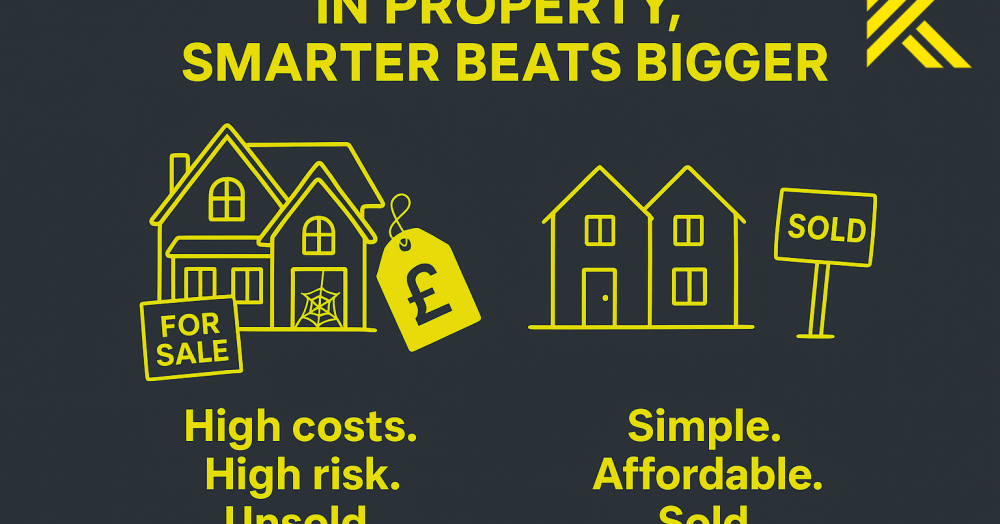
More Square Footage, More Problems - Why Bigger Isn't Always Better In Housing Design
Good design isn’t about more square footage. It’s about creating cost-effective homes people actually want to live in and can afford.
🏡 We recently sold a plot of land in Sevenoaks quickly, smoothly and without fuss.
No glossy brochure.
No flashy Rightmove ad.
No Hollywood-style sales pitch.
Just a few phone calls to the right buyers.
The key? The designs were simple, small, and financially viable.
- Cost-effective to build ✅
- Easy to sell once built ✅
- Zero risk of being stuck on the market gathering digital dust ✅
Now, compare that to what you see endlessly scrolling on Rightmove:
💸 Oversized, high-spec “dream homes” with unrealistic GDVs
🏚 Plots that sit unsold for months (if not years)
🕳 Developers left with nothing but uncertainty and a large hole in their pocket
The reality is: most developers don’t want to build big houses with even bigger costs, only to cross their fingers and hope someone will buy. They want certainty. They want to build units that sell quickly, cover finance, and keep cash flowing.
And here’s a truth many overlook:
The people who can afford a ‘dream home’ probably don’t want yours — they’ll want to design their own. Which is why so many “one-plot wonders” never shift.
At our end, we appraise countless sites every month and keep finding ourselves asking the same question:
👉 “Why so big?”
More often than not, the build costs are so inflated that the scheme the landowner spent good money on turns out to be completely unfeasible.
The site in Sevenoaks worked because it balanced design, cost, and demand.
That’s what makes a site successful in today’s market — not square footage for the sake of it.
So, if you were developing a site today…
Would you go bigger — or smarter?
If you're a landowner who would like an idea of how to maximise your site's potential, an architect who would like help pre appraising a site before submitting the application or a developer looking for your next project, drop me an email, give me a call or drop me a DM.
📧 karl@kallars.com
☎️ 0203 848 1399